
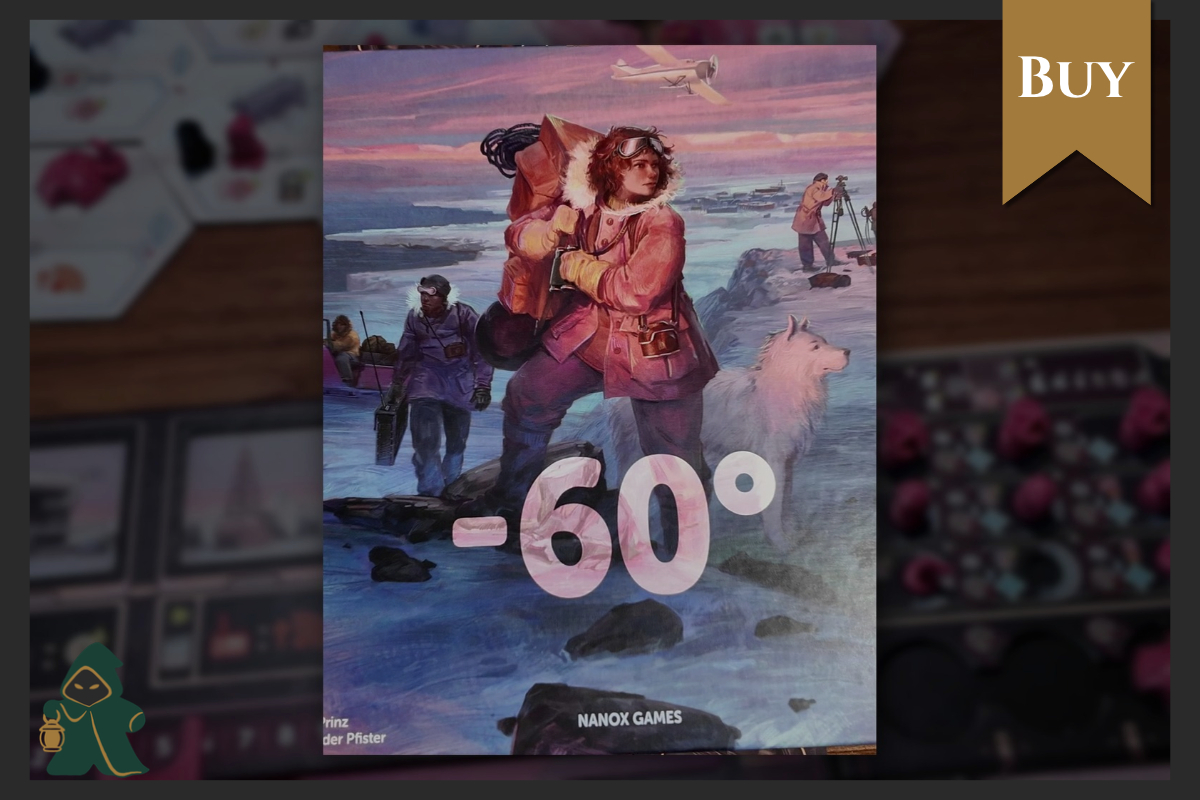
Verdict: BUY (first impression, after one play)
Buy if you love diverse options and sprawling choices, and you’re willing to invest the time to find a strategy and stick with it.
Why: every single part of this game gives you a real choice, and every road I saw felt viable.
What is -60° Sixty Below?
-60° (Sixty Below) is a heavy euro by Alexander Pfister and Peter Prinz, published by Nanox Games and one of the big hits of SPIEL Essen 2026. It plays 1 to 4 players in 120 to 180 minutes, with a solo mode. The setting: an alternate-history Antarctica in 1971, where research teams race to reach the site of a meteorite impact.
It mixes deckbuilding, push-your-luck and worker placement, which makes it a lot in one box.
How it plays
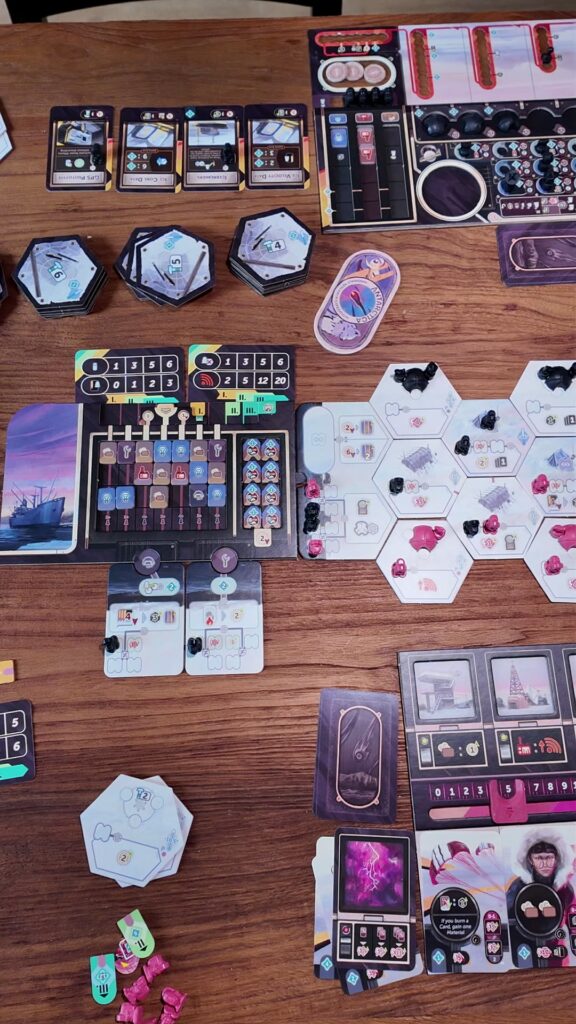
The game runs over six rounds. Each round you draw cards from your deck one at a time and decide when to stop. Storm cards give you energy, but the more of them you reveal, the less your expedition cards do, so pushing too far can kill your turn. Then you place explorers on action spaces, and they never come back: every space you take stays blocked for the rest of the game, for everyone. You build stations, explore new tiles that grow the map, buy cards for your deck and play projects that make your future actions stronger.

What works
Every road feels viable
Every part of the game gives you real choice, and that is a big part of why it’s a buy for me. There are so many different roads to go down, and each one felt viable. I went heavy on projects and tried to chain them: one let me burn cards, the other gave me materials every time I burned a card. Because of that I unlocked my fourth building early, which gave me an extra spot to put drawn storms without locking my actions. Bas went heavy on communication and radio and removed all the storms from his deck, which gave him loads of expedition cards and actions every turn. In the end his strategy combined really well with the goals. But both options seemed viable.
Storms are a real decision
Dealing with the storms feels like a real choice. Do you strip them out of your deck, or go a different route? Keeping two storms can also work if your other cards give you good stuff for it. Next game I want to take more risks early: a few storms at the start give you a lot of energy, and you can spend that on new cards and projects that make your future actions stronger. I played it a bit safe, and I’m very excited to try again and see if I can do better.
Projects are yours alone
I liked that the project cards are for your own use only. They give every player new options that you can actually save for the right moment.
It looks beautiful
The game is very beautiful. I like the art and the arctic feel, and it’s a nice change from all the cozy woodland games we’ve seen lately. The iconography is very clean too, and that was easy to learn.
Reasons to come back
I can’t fully say after one play how replayable it is. But I can see more roads to try, and with different goals there’s a real incentive to try new strategies each game. I see myself playing it more often and trying new routes to different victories.


What doesn’t work
The explore action makes no sense to me
Exploring gives you very little: one radar token. Then your explorer is stuck on that tile forever. It does flip the tile over, which gives the next player new worker placement options. So the space you spent resources to open might not be available to you at all by the time your turn comes around again. That’s a real downside for me. It doesn’t just bother me: I can’t make sense of why it would be designed this way.
The theme is just there
The theme doesn’t really come through. A meteorite crashed, go explore, and that’s it. Nothing in the rulebook or on the cards adds to or changes that story. It could just as well have been a meteorite in the jungle, or an interesting fossil found in the Arctic with a base set up around it. The theme exists, but that’s all it does.
The first game is overwhelming
It’s a big game, and the first part of it felt incredibly overwhelming. We chose our first cards and goals based on nothing, because you don’t know where to go yet. There are a lot of mechanics. I thought the explorers in the harbour also counted as presence, which they don’t, so I didn’t have enough presence to build my last upgrade even though I had all the materials. That sucked, but it’s a mistake I won’t make again. There’s a learning curve and your first play will take some time, but if you’re willing to invest that time it clears up quickly.
The production feels rushed
There are some component issues. They aren’t game-breaking, but they’re not ideal:
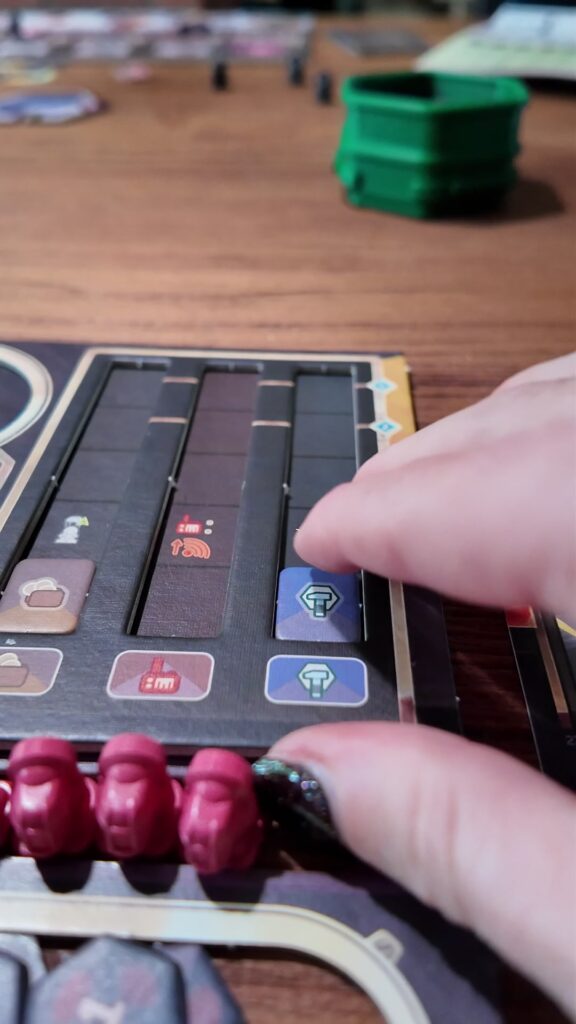
- The holes for the upgrades in the double-layered boards are just a tiny bit too small, so you really have to jam the pieces in, and that doesn’t feel great.
- Two stickers to hold the double-layered boards together isn’t enough. They lift up on the experts side, and the experts slide under the board, which is not great when you need them.
- The rulebook has a bunch of grammar and text errors.
Nothing game-breaking, but that shouldn’t happen with an 80 euro game.

Who is it for?
If you love diverse options and sprawling choices, this is a great game. It takes mechanics from a lot of different games: the experts compare to Great Western Trail, the deckbuilding feels like Arnak or Terraforming Mars, and there’s worker placement on top. So it’s a lot in one.
Don’t go in expecting a lot of player interaction. You do get in each other’s way, because spaces get blocked for good. That was annoying at times, but I like it when a game forces you to pivot. Beyond that there’s nothing direct, and if interaction is what you’re after, you won’t have fun.
Skip it if you’re not willing to invest the time. It’s a big game, and you need to be able to find a strategy and stick with it.


Verdict: Buy
Buy, so far. The explore action, the thin theme and the rushed production are real downsides. But every part of this game gives you a real choice, and after one play I already know what I’d do differently. I’m very excited to try again.
How I played
- Plays: 1 (this is a first impression, not a full review)
- Players: 2
- Length: about 3 hours, including a bit of teaching and punching the components
- Solo: not played yet. There’s a solo mode against a bot called Arka.
- Copy: bought with my own money at SPIEL Essen 2026. Not a review copy, no affiliate links.